Adoption · paying clinics
0%
use purchase-order upload, the 2nd most-adopted of 13 AI features (history summaries led at 73%). Snapshot, June 2026.
Case Study · Since 2024
Co-created an AI product for veterinary clinics, then used real usage data to investigate why the feature we bet on wasn't being adopted.
Role
Co-creator · Product Designer
Period
2024 – Present
Scope
Research · feature priorities · usage KPIs · adoption diagnostics
Team
With product & engineering
SlothVet is an AI product for veterinary clinics, born inside Wakyma, the veterinary practice-management software where I work. Its premise is simple: give vets back the time that admin and management steal from patient care.
I've been involved since the product's conception in late 2024, shaping it from the first round of research through to the usage instrumentation we run today.
Problem
In a veterinary clinic, time is the scarcest resource. Between appointments, vets pile up work that has nothing to do with caring for animals: writing up records, replying to reviews, reconciling inventory, chasing delivery notes. That paperwork eats hours that should belong to patients, and it usually happens at the worst time: at night, at home, or stacked up for the free moment that rarely comes.
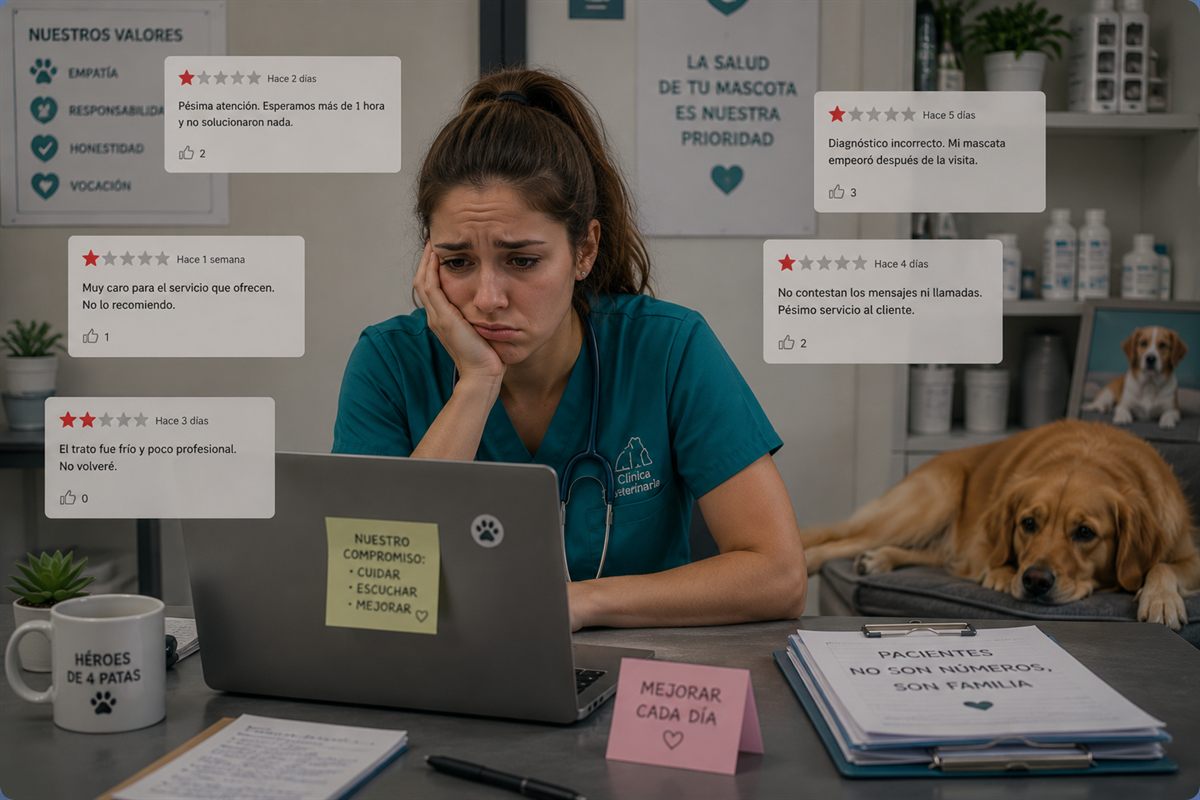
Before designing anything, I scheduled and ran more than ten one-hour interviews with real Wakyma clients, to understand how they actually managed consultations, reputation, and inventory, and where their sharpest friction was.
During the feedback phase I also went into clinics in person, omnidirectional microphone in hand, to test the consultation-notes feature in real appointments, because a voice AI isn't validated in a demo but in the noise of a room with an animal on the table. Three painpoints kept surfacing across every conversation.
Time scarcity
Vets described the clinic as a place that swallows the whole day. Clinical notes and reports ended up written from memory, at night or whenever a free moment finally came.
Reputation slipping
Reviews left unanswered for sheer lack of time, a slow drain on the clinic's standing that everyone noticed but no one could keep up with.
Admin and inventory burden
Medication stock control, vaccination records, and regional registries added steps to every consultation, turning routine care into paperwork.
All three mapped directly onto what SlothVet went on to build: automatic notes, a reviews assistant, and delivery-note and invoice upload.
“When I walk into the clinic I fall into a black hole I only climb out of when I leave — there just aren’t enough hours in the day.”
Field research: interviews and in-clinic visits across veterinary practices.
SlothVet set out to give that time back by automating the administrative load with AI, without making vets change how they work or switch software.
One finding set the strategy: at that moment, no veterinary practice-management software in Spain had shipped AI tools. So instead of building SlothVet only inside Wakyma, I helped frame it as two products in parallel: one integrated into Wakyma and one standalone, so any clinic, whatever system it already used, could adopt AI without migrating tools.
That decision shaped everything downstream: the standalone product had to earn trust on its own, while the integrated one could lean on the data Wakyma already held. Both shipped — and the standalone is live and growing today, bringing SlothVet's AI to clinics on other practice-management systems. For Wakyma it was also a business bet: being the first vet practice-management software in Spain to ship AI, a differentiator that's hard to copy and a selling point against the competition. The adoption data that follows comes from the Wakyma-integrated product.
The Wakyma-integrated version leaned on its CRM (including animal-history summaries), while standalone SlothVet started lean (consultation recording, reports, and reviews/surveys), with no record management yet.
From there, continuous feedback (a Canny forum, support chat, phone calls, and follow-up interviews with early testers) drove the roadmap: per-user AI permissions inside Wakyma, client and pet records with saved consultations in the standalone product, and delivery-note and invoice upload to speed up inventory management.
Two of those were Human-AI design decisions I owned end to end. I made AI permissions granular by tool and by employee, so each clinic controls exactly who can use which AI feature. And I designed the invoice/delivery-note upload so it never writes to inventory blindly: when the AI isn't confident it read a document correctly, or detects a duplicate of one already uploaded, I have it surface that item with a ‘Review’ flag instead of quietly committing it — keeping a human in the loop before anything reaches the inventory.
Over ten one-hour interviews, in-clinic testing, and 7 and 30-day usage KPIs. Measured across paying and freemium clinics.
Adoption · paying clinics
0%
use purchase-order upload, the 2nd most-adopted of 13 AI features (history summaries led at 73%). Snapshot, June 2026.
Purchase-order upload · volume
0
documents processed in a 30-day window, about 34 a month for every clinic that uses it.
Admin time returned
0 to 3 h
per active clinic each month; a complex purchase takes 10 to 15 min to key in by hand versus about 5 with the assistant.
And those 2-3 hours come from a single feature. The other one I can measure with real data, history summaries (the most-adopted, at 73%), adds its own share: about 7 times a month per clinic, the 7-8 minutes it takes to comb through years of a clinical file by hand — chronic conditions, history and what matters about the case — collapse into 15 seconds, ready to review or send to another clinic. That is, conservatively, close to another hour a month per clinic. And these are just two of the thirteen features.
% of paying clinics that used each feature in the last 30 days · snapshot June 2026
The features that remove admin and clinical-writing load lead adoption. The voice-driven consultation notes (the feature we expected to lead) came in lower, even in paying clinics where they are fully available. That gap is what I set out to diagnose.
What vets say
Those administrative and inventory tools were thriving (the data above). The feature we'd bet on as the flagship, though, told a different story: automatic consultation notes sat at just 45% among paying clinics, below the very tools it was meant to headline. Fully available there and still trailing the admin features, that 45% was the real mystery to solve.
The team's first hypothesis was hardware, and an aggressive offer was already on the table: a year of discount plus a free omnidirectional microphone. I pushed back. Spending the budget there assumed we already knew the cause, and nothing I'd heard from vets supported it. So instead of guessing, I made the call to instrument the problem, with two mechanisms designed to tell the competing explanations apart: a literal transcript of each consultation, which shows whether the audio came in clean or the AI misheard it, and a per-consultation survey that captures, in the vet's own words, what failed when the notes still weren't useful. Each result points to a different fix: bad audio would finally justify the microphone offer, with evidence behind it; clean audio with wrong notes points at the model; accurate notes left unused points at the workflow. Both mechanisms are in implementation as of June 2026. The result I'll stand behind isn't a recovered adoption number yet, it's the decision itself: we didn't burn budget on an unverified fix, we built the experiment that finds the cause. In a product still finding its footing, choosing to learn over guessing is the outcome.
“It isn’t quite right and needs too many corrections, so it doesn’t save any time.”
The most useful lesson was to distrust the assumed 'star feature': a feature being used less than expected doesn't mean it's redundant. It means you don't understand the friction yet. Designing for AI adoption turned out to be less about improving the output and more about building verification and trust around it.